





Pete’s wheel & tire resource • Updated November 13, 2026
The right golf cart wheels and tires should fit your cart, suit the surfaces you drive and give you the look you want. This guide walks you through the numbers, the tradeoffs and the checks that matter before you order.
1. Start with your cart, not the wheel photo
Before comparing finishes and spoke patterns, collect five details. They help you avoid buying a good-looking setup that rubs, mounts incorrectly or needs parts you did not plan for.
- Make, model and year: “Club Car” or “Yamaha” alone is not specific enough. Identify the exact model and any production-year changes.
- Current tire size: Photograph the complete sidewall marking on the front and rear tires. A used cart may already have non-original equipment, so compare with the vehicle’s documentation.
- Current wheels: Record diameter, width, bolt pattern and offset or backspacing when available. Do not measure the outside of the tire and call that the wheel size.
- Suspension and body changes: Note a factory lift, aftermarket lift brand and part number, fender flares, replacement body and rear seat kit.
- Use and load: Think about pavement, golf-course rules, gravel, trails, passengers, cargo and how much garage or trailer space you have.
Need a starting point? Identify your golf cart’s model and year, or send our team photos and your cart details.
What is a standard golf cart tire size?
18×8.5-8 is a familiar size on many traditional golf-course carts: approximately 18 inches tall on an 8-inch wheel. It is a starting reference, not a specification for every cart. Personal, utility, factory-lifted and low-speed vehicles can have different original equipment. Verify your particular vehicle.
2. Read the complete tire size
Golf cart tires commonly use two size formats. Both describe tire dimensions, but they express sidewall information differently. These are nominal labels; the manufacturer’s measured specifications are the better reference for final clearance checks.
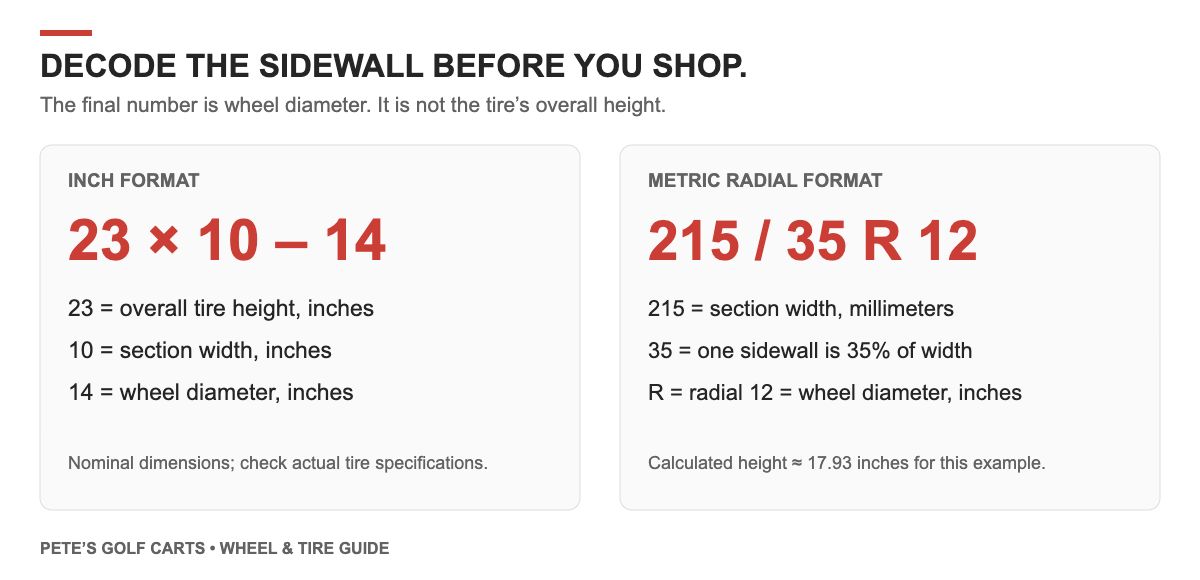
Inch sizing: 23×10-14
- 23: nominal overall tire diameter, in inches.
- 10: nominal section width, in inches.
- 14: wheel diameter, in inches.
A tire marked 23x10R14 uses the same dimensional idea, with “R” identifying radial construction. A 23-inch tire is not a 23-inch wheel.
Metric sizing: 215/35R12
- 215: nominal section width, in millimeters.
- 35: aspect ratio; one sidewall is 35% of the nominal section width.
- R: radial construction, when shown.
- 12: wheel diameter, in inches.
The sidewall in this example is 215 × 0.35 = 75.25 mm, or approximately 2.96 inches. Add two sidewalls to the 12-inch wheel and the calculated tire height is approximately 17.93 inches.
The formula: overall diameter in inches = wheel diameter + 2 × (section width in mm × aspect ratio ÷ 100 ÷ 25.4). The calculator below handles that arithmetic for you.
A few useful size comparisons
| Tire marking | Wheel diameter | Calculated / nominal tire height | Approx. sidewall height |
|---|---|---|---|
| 18×8.5-8 | 8 in | 18.00 in | 5.00 in |
| 205/50-10 | 10 in | 18.07 in | 4.04 in |
| 215/35-12 | 12 in | 17.93 in | 2.96 in |
| 205/40-14 | 14 in | 20.46 in | 3.23 in |
| 23×10-14 | 14 in | 23.00 in | 4.50 in |
| 23x10R15 | 15 in | 23.00 in | 4.00 in |
Calculated metric sizes and nominal inch sizes are approximate. Actual inflated diameter and width vary by tire model, measuring rim and operating conditions. A mathematical conversion does not guarantee that an equivalent tire is sold.
3. Interactive golf cart tire size calculator
Use this tool to decode a tire or compare the dimensions of two sizes one at a time. It estimates overall height, width, sidewall height, circumference and revolutions. Keep your current-size result handy, then enter the size you are considering.
Golf Cart Tire Size Calculator
Enter one tire size to estimate its dimensions in inches and millimeters. This tool calculates size; it does not check whether a tire fits your cart or select a lift kit.
Try an example:
Your calculated dimensions will appear here.
| Measurement | Inches / US | Millimeters / metric |
|---|---|---|
| Overall tire height | — | — |
| Wheel diameter | — | — |
| Sidewall height | — | — |
| Section width | — | — |
| Circumference | — | — |
| Theoretical revolutions | — per mile | — per km |
Nominal size math is an estimate. Manufacturer dimensions, approved rim width, inflation, wear and load affect the installed tire. Revolutions are geometric estimates, not measured rolling-revolution data. A calculated size is not a product recommendation or a guarantee of fitment.
How to use the result: A change from 18 to 22 inches in overall tire diameter raises the axle approximately 2 inches from the tire change alone—not 4 inches. That is a geometric estimate before tire deflection and any suspension changes. It does not tell you whether a 22-inch tire clears your cart.
4. Bigger wheel, taller tire—or both?
These are two different upgrades. You can increase wheel diameter while keeping overall tire height close to the original, or keep a smaller wheel and mount a taller compatible tire. Wheel width must also fall within the tire manufacturer’s approved range.
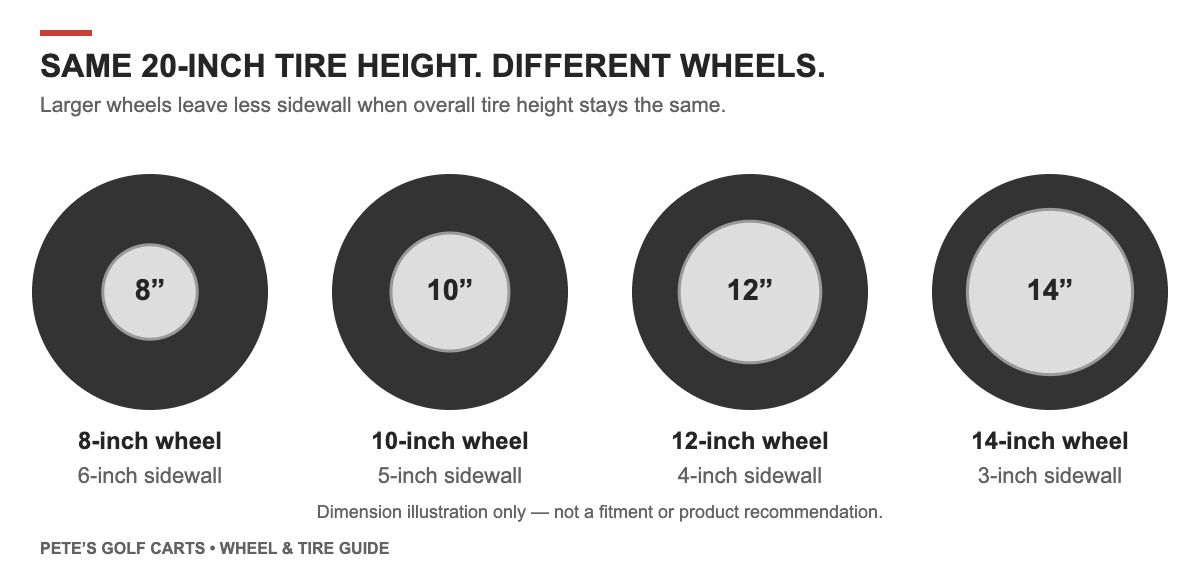
Low-profile describes sidewall proportions, not terrain
A larger wheel inside a tire of the same overall height leaves less sidewall. That can create the sportier look you want, but generally leaves less cushioning between the wheel and a bump. Construction, inflation, suspension, load and tire design also influence ride quality. A low-profile tire is not automatically radial, street-rated or suitable for every stock-height cart.
Steel or aluminum wheels?
Steel can be a practical replacement choice; aluminum offers a wide range of spoke designs and finishes. Compare the actual wheel’s weight, load rating, corrosion-care instructions and finish rather than assuming every alloy wheel is lighter or stronger. Center caps and lug hardware may be separate items.
Choose the whole package
Compare the overall tire height + section width + wheel diameter + wheel width + offset. A listing described as “14-inch wheels” tells you only part of the story. For example, 205/40-14 and 23x10-14 both use 14-inch wheels but differ substantially in height and clearance needs.
5. Match tread and construction to your driving
Start with the surfaces where your cart spends most of its time. Choose appearance after intended use, load capability and fitment are established.
| Your driving | What to compare | Shopping path |
|---|---|---|
| Pavement and neighborhood routes | Street-oriented tread, ride characteristics, load and speed ratings, and the tire’s stated road-use suitability. | Street & turf tires |
| Golf courses and maintained lawns | Turf-oriented designs and the course’s rules. Turning, braking, moisture and vehicle weight can still mark grass. | Compare turf options |
| Gravel, packed dirt and mixed routes | All-terrain patterns suited to the balance of pavement and loose surfaces you actually use. | All-terrain tires |
| Mud, sand or specialized off-road use | Patterns intended for your terrain. A mud tread is not automatically the best sand tire, and aggressive tread can compromise pavement comfort or turf care. | Mud & sand tires |
Radial, steel-belted radial and bias-ply
Construction is separate from tread. Radial tires use a different internal cord arrangement from bias-ply tires; some radials also use steel belts. Compare the specific tire’s ride characteristics, approved application and specifications. Do not assume every radial is steel-belted, every all-terrain tire is bias-ply or a ply rating describes the literal number of fabric layers.
Read load and speed information
Check the tire and wheel ratings against the vehicle’s requirements, intended load and operating speed. Adding the four tire ratings together does not increase the cart’s passenger or cargo capacity. A lift kit, wider stance or new rear seat does not by itself increase the vehicle’s load rating.
6. What fits? Check the cart and lift kit together
A universal “tire height equals lift height” chart is too blunt for a final buying decision. Two carts from the same brand can have different suspension, bodywork and wheel requirements. Two tires with the same marked size can also have different measured dimensions.
Use tire height to narrow the search
| Overall tire-height range | Practical starting point | What still needs checking |
|---|---|---|
| Around 18 inches | A familiar replacement-height starting point for many traditional carts. | Your exact original size, tire width, wheel specifications and brake clearance. |
| Around 20–20.5 inches | Check closely before treating this as a stock-height fit. | Model, actual tire dimensions, suspension condition, offset, load and clearance through steering travel. |
| Around 22–23 inches | Start with a compatible factory-lifted or aftermarket-lift application. | The exact lift-kit instructions, required wheel diameter and offset, tire width and complete installation. |
| 24 inches and taller | Treat as a specialized setup requiring application-specific confirmation. | Kit approval, body and suspension clearance, gearing, braking and overall vehicle limits. |
These are shopping checkpoints, not guaranteed fits or minimum lift specifications. The vehicle and lift manufacturer’s application requirements take priority.
EZGO: identify the platform and production range
TXT, RXV, Marathon and Express applications are not interchangeable. Verify model, production range, gas or electric powertrain and any factory lift before selecting a kit. Wheel and tire requirements belong to the exact kit, not just its advertised lift height.
Club Car: separate DS, Precedent, Tempo and Onward
Do not assume a kit for one Club Car platform fits another. Onward factory-lifted and non-lifted applications also need to be distinguished. A rear seat, extra passengers or worn suspension can change rubbing behavior even when the tire clears an unloaded cart.
Yamaha: Drive and Drive2 are different applications
Confirm the specific G-Series model or Drive/Drive2 platform, year and powertrain. Read any suspension-specific restrictions. “Fits Yamaha” is not enough information to select a lift, wheel or tire package.
Check clearance through movement, not just while parked
Before committing to a setup, have a qualified installer assess inner suspension clearance, fenders, floorboards, brake components and steering at full lock in both directions. Clearance must also account for suspension travel and the expected passenger or cargo load. Do not use an improvised spacer or trim structural parts as a substitute for a compatible combination.
7. Bolt pattern, offset, backspacing and lug nuts
A wheel can have the right diameter and still be wrong for your cart. Confirm its attachment and clearance dimensions before choosing the finish.
Bolt pattern: 4x4 is not 4x100
Many traditional golf carts use a four-lug 4x4-inch pattern, equivalent to 4x101.6 mm. Do not substitute a 4x100 wheel or assume every golf cart, GEM or low-speed vehicle shares the same pattern. On a four-lug hub, the bolt-circle diameter is measured center-to-center across opposite studs. Also check center-bore and brake clearance.
Offset: where the mounting face sits
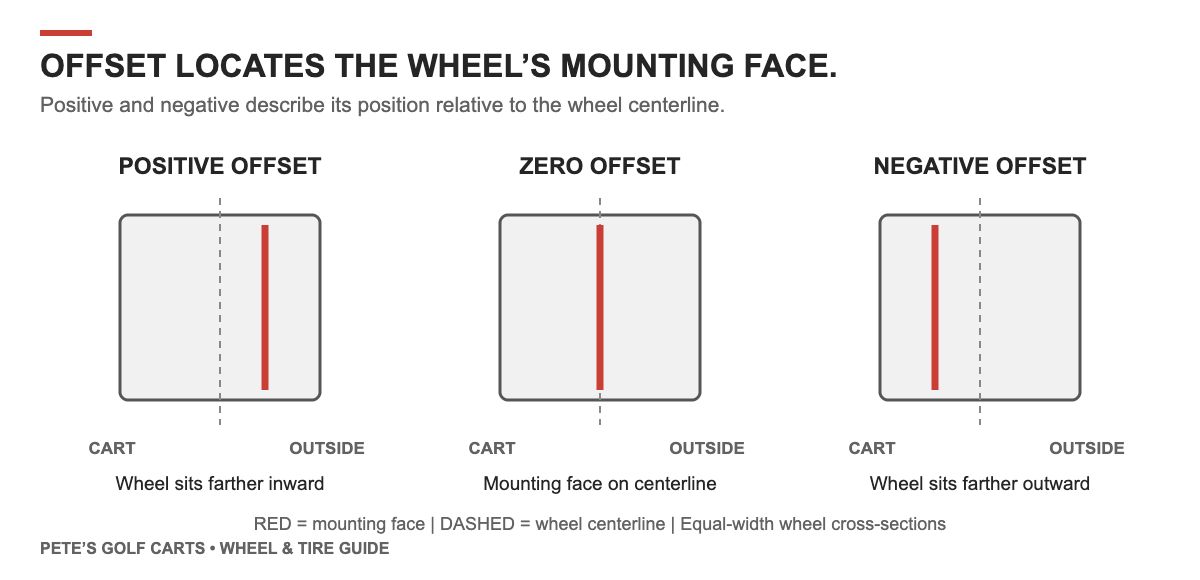
Offset is the distance between the wheel’s centerline and its hub-mounting face, normally stated in millimeters. For wheels of equal width:
- Positive offset: the mounting face sits toward the wheel’s outward-facing side; the wheel sits farther inward.
- Zero offset: the mounting face is on the wheel’s centerline.
- Negative offset: the mounting face sits toward the cart-facing side; the wheel sits farther outward.
Backspacing measures from the inner wheel lip to the mounting face, usually in inches. Wheel width is normally a bead-seat measurement, so do not casually substitute nominal width for outside lip-to-lip width when calculating backspacing. Some golf-cart listings use split measurements such as “3+4”; confirm the seller’s convention rather than assuming which number faces inward.
Lug nuts and hardware matter
Match the stud thread, lug-seat shape, nut length and required engagement to the vehicle and wheel. A nut that threads on is not necessarily the correct seat for the wheel. Check whether a package includes the right hardware or requires a separate selection, and follow the specified installation torque.
8. What changes in ride, acceleration and range?
Wheels and tires change more than appearance. Taller overall tires change the distance traveled per axle revolution, while assembly weight, tread, inflation and width influence the load on the vehicle.
- Acceleration and hills: a taller tire changes effective gearing. With the same drivetrain, expect a tradeoff in wheel force rather than a free performance upgrade.
- Speed indication: a tire-height change can affect a speed reading calibrated to the old rolling circumference. It does not authorize a higher vehicle speed.
- Range: weight, rolling resistance, inflation, terrain and driving habits all matter. There is no reliable universal mileage gain or loss from wheel diameter alone.
- Ride: compare sidewall, construction and the correct operating pressure. Larger wheels are not automatically smoother.
- Overall size: measure the finished cart for garage doors, trailers, storage and fender coverage.
Worked example: going from a nominal 18-inch to 22-inch tire increases geometric circumference by about 22%. That means 22% more distance per axle revolution in this simplified comparison—not a guaranteed 22% increase in real-world speed. Motor, gearing, controller, load and manufacturer limits still govern the vehicle.
9. Installation, pressure and ongoing care
Use the correct pressure for the application
Check cold tire pressure with a gauge. For original equipment, use the vehicle’s specified tire pressure. For an aftermarket combination, confirm an appropriate operating pressure with the tire manufacturer or qualified installer using the vehicle load and tire specifications. A sidewall maximum or a pressure associated with a maximum-load rating is not automatically the recommended everyday setting. There is no one PSI that suits every golf cart tire.
Mounting, alignment and hardware
Have tires mounted using appropriate equipment and verify directional arrows or inside/outside markings where present. Confirm bead seating, valve condition and leaks. Follow the vehicle, wheel and lift instructions for lug torque, alignment and any recheck interval. If a newly installed package vibrates, pulls or wears unevenly, have it inspected rather than treating that as normal.
When should tires be replaced?
Inspect tread, sidewalls and valves regularly for damage, cracking, bulges, persistent pressure loss and uneven wear. Age, storage and usage matter as well as tread depth. Follow the tire manufacturer’s inspection and replacement guidance; a blanket “replace every three to five years” promise is not a reliable rule for every tire. Do not continue using a damaged tire just because it still has tread.
10. Choose your shopping path
Once you know the target dimensions and fitment requirements, decide what you actually need to buy. The package description should make clear whether you are getting bare wheels, tires only, individual mounted assemblies or a full set.
| Your project | Start here | Confirm before checkout |
|---|---|---|
| Keep the cart near its current ride height | Stock-height wheel & tire packages | Exact model fitment, actual tire height and width, offset and load clearance. |
| Build around a compatible lift | Lifted wheel & tire packages | Lift part number, minimum wheel size, offset, tire limits and included hardware. |
| Keep your existing compatible wheels | Replacement golf cart tires | Wheel diameter and approved width, tire specifications and mounting arrangements. |
| Keep your tires and change wheels | Golf cart wheels | Tire compatibility, wheel ratings, bolt pattern, offset, lug seats and brake clearance. |
Before you order: a quick checklist
- Exact cart model, year and current modifications confirmed.
- Tire height, width, construction and load/speed ratings reviewed.
- Wheel diameter, width, bolt pattern, offset and lug hardware matched.
- Lift-kit requirements and clearance under steering and load checked.
- Quantity, mounting, balancing, valves, center caps and lug nuts checked against the listing—not assumed included.
- Current availability, delivery terms and return conditions reviewed before mounting or installation.
Real builds, different goals


Customer photos are style inspiration. A photo alone cannot establish tire size, lift specifications or compatibility with another cart.
11. Golf cart wheel and tire questions
What size tires fit my golf cart?
Start with the exact vehicle model, year, existing tire size and suspension setup. Then check the proposed tire’s actual dimensions and wheel specifications against the vehicle and lift requirements. Our calculator decodes dimensions; it does not certify fitment.
Can I use 12-inch or 14-inch wheels without a lift?
Possibly, when a compatible low-profile tire keeps the overall height and width within your cart’s limits and the wheel meets all mounting and clearance requirements. Wheel diameter by itself does not decide whether a lift is needed.
Will a 20-inch tire fit without a lift?
There is no all-cart answer. Model, actual tire size, wheel offset, suspension condition and load can change the result. Do not assume that “20 inches” or a stock-height category label is a fitment guarantee.
Does R mean the wheel radius?
No. R identifies radial tire construction. In 23x10R15, the 15 still identifies the wheel’s diameter in inches.
Are DOT-marked tires enough to make my cart street legal?
No. The DOT symbol is the tire manufacturer’s certification that the tire meets applicable federal standards. It does not certify the entire cart or grant permission to drive it on public roads. Confirm the vehicle and local road-use requirements for your location.
Are all-terrain tires safe for golf-course grass?
Do not assume that they are permitted or turf-friendly. Check the specific tire’s intended use and your course’s rules. Tread, tire pressure, load, wet ground and turning behavior all affect turf impact.
How much ground clearance does a taller tire add?
Approximately half the increase in overall tire diameter at the axle, before loaded tire deflection. Moving from an 18-inch to a 22-inch tire is a nominal 2-inch increase from tires alone, separate from any suspension lift.
Should I replace tires based on age or tread?
Both matter, along with damage and pressure retention. Follow the tire manufacturer’s guidance and have questionable tires inspected. Plenty of tread does not make a cracked or damaged tire serviceable.
Let’s find the right setup for your cart
Send Pete’s your make, model, year, current sidewall size and lift-kit details. Include a photo of the cart and wheel markings if you have them, plus how you use it and the look you want. We can help narrow down options before you place an order.
Call or text 772-247-4653.
Manufacturer references and further reading
Use the current instructions for your exact vehicle, tire, wheel and lift kit when making a purchase or installation decision. These references explain the principles used in this guide.
- Michelin: tire markings, construction and pressure labels
- Tire Rack: wheel offset and backspacing
- Kenda: golf tire dimensions, rim sizes and load specifications
- Club Car: vehicle maintenance and pressure guidance
- RHOX: example of kit-specific wheel and tire requirements
- NHTSA: what the DOT tire marking certifies